
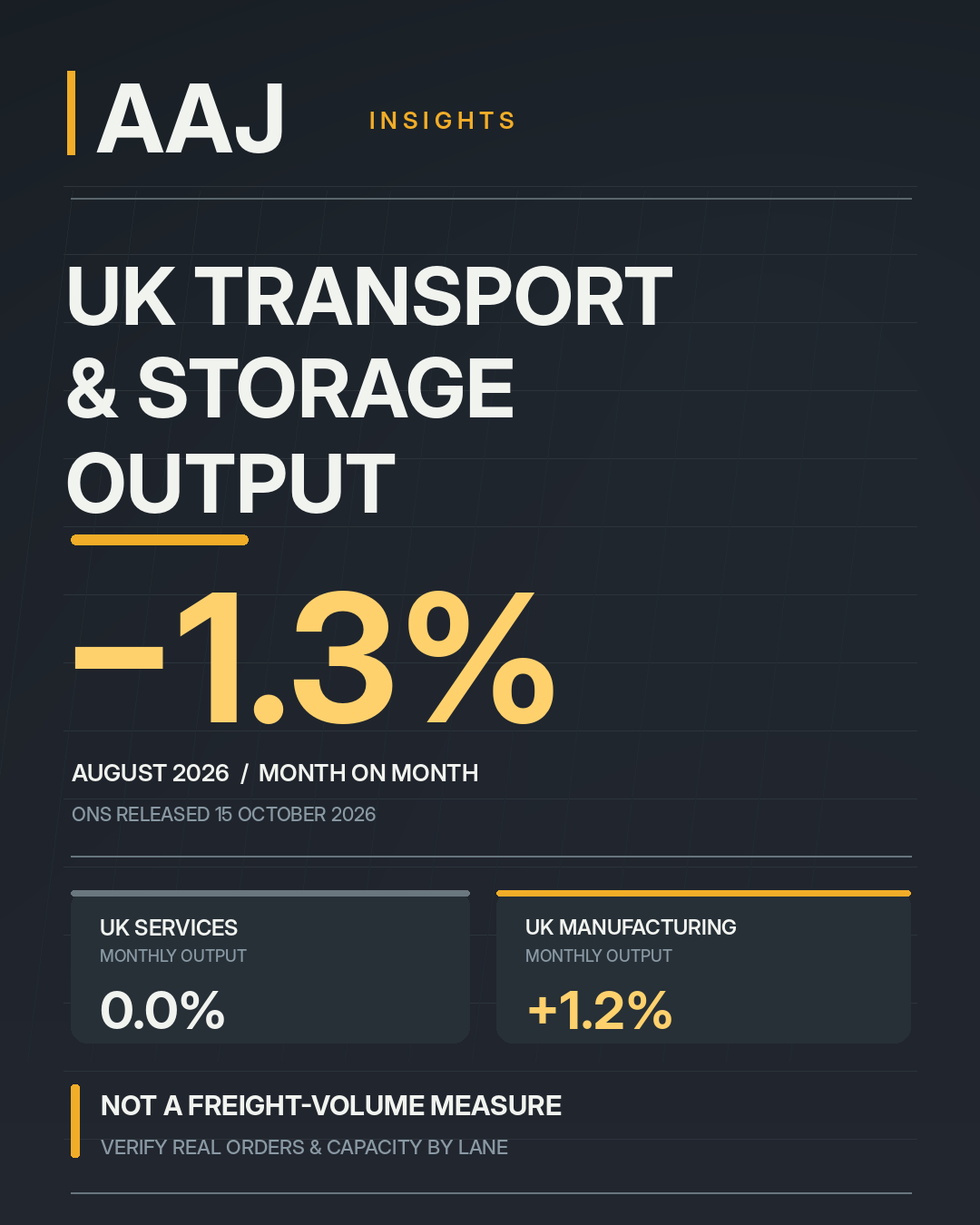
In its Index of Services release on 15 October 2026, the Office for National Statistics estimated that UK transportation and storage output fell by 1.3% in August compared with July. Overall services output was flat that month, while manufacturing output rose by 1.2%. The numbers highlight differences between sectors, but the transport-and-storage index is not a count of freight tonnes, lorry trips or available capacity on a particular route.
A softer month in transport and storage
The ONS Index of Services bulletin released on 15 October 2026 estimates that the output of the broad transportation and storage sector declined by 1.3% month on month in August. Across services as a whole, estimated output was unchanged (0.0%) over the same period, following monthly increases of 0.5% in both June and July.
The release also says that 9 of the 14 service sectors contracted in August. The transport-and-storage decline was among the notable negative monthly contributions. These seasonally adjusted figures describe estimated economic output in the sector, not shipments or vehicle movements.
What the indicator cannot tell a shipper
It would be a mistake to infer from the 1.3% reading that HGV capacity rose by 1.3%, that warehouse space became cheaper, or that a particular UK–EU corridor has weak demand. Transportation and storage combines several activities and is measured in terms of economic output rather than operational tonne-kilometres, containers, pallets or vehicles.
Changes in business mix, service value, pricing, and the underlying data can move economic indicators differently from actual freight activity. The ONS also notes that service output estimates are subject to uncertainty and revision. Treat this figure as an invitation to check the details, not as an automatic basis for negotiating or changing a rate.
Manufacturing and trade offer useful context, not a forecast
The separate ONS Index of Production bulletin, released the same day, estimates that manufacturing output grew by 1.2% month on month in August. Basic pharmaceutical products increased by 5.1%, accounting for over half of that month's manufacturing growth. A rise in one production category does not necessarily produce a comparable rise in UK truck movements.
ONS trade data also show that August goods imports from the EU increased by £0.5 billion (1.6%) in current prices compared with July, while goods exports to the EU fell by £1.2 billion (7.3%). These values are not the weight or number of consignments moved. They do underline why inbound and outbound flows must be monitored separately rather than averaged into one UK freight outlook.
Four checks before changing a freight plan
First, review firm orders and collection-ready dates by origin, destination and commodity group. Second, ask carriers or forwarders for actual service availability on those lanes, not a national trend extrapolation. Third, compare the last four weeks of lead times, missed collections, storage dwell and quote validity. Fourth, split imports from exports and scheduled contract work from spot bookings.
A general economic-output slowdown can coexist with a shortage of capacity on a specific departure, port or delivery window. Conversely, a national rise in manufacturing may not affect a route with different cargo or seasonality. Use the macro figures only as prompts for a more precise operational conversation.
What to brief the booking desk
For each movement, provide the cargo-ready date, exact loading and delivery sites, package count, dimensions and mass, any handling restrictions, latest delivery time and customs responsibilities. Mark which details are confirmed and which could change. Ask for the transport mode, included services, waiting-time assumptions and earliest realistic collection slot in writing.
Repeat the same lane-level review when the November ONS figures arrive, but do not wait for another statistical bulletin to resolve a live booking exception. Actual confirmed consignments and supplier commitments remain the operational source of truth.
Takeaway
August's 1.3% fall is a UK transportation-and-storage output estimate—not a freight-volume or capacity figure. Use it to trigger a lane-by-lane review of firm orders, quote validity, actual availability and delivery performance.
Sources
- Office for National Statistics — Index of Services, UK: August 2026 (released 15 October 2026)
- Office for National Statistics — Index of Production, UK: August 2026 (released 15 October 2026)
- Office for National Statistics — UK trade: August 2026 (released 15 October 2026)
Practical reading for this route. Check the official guidance for the circumstances of your shipment.