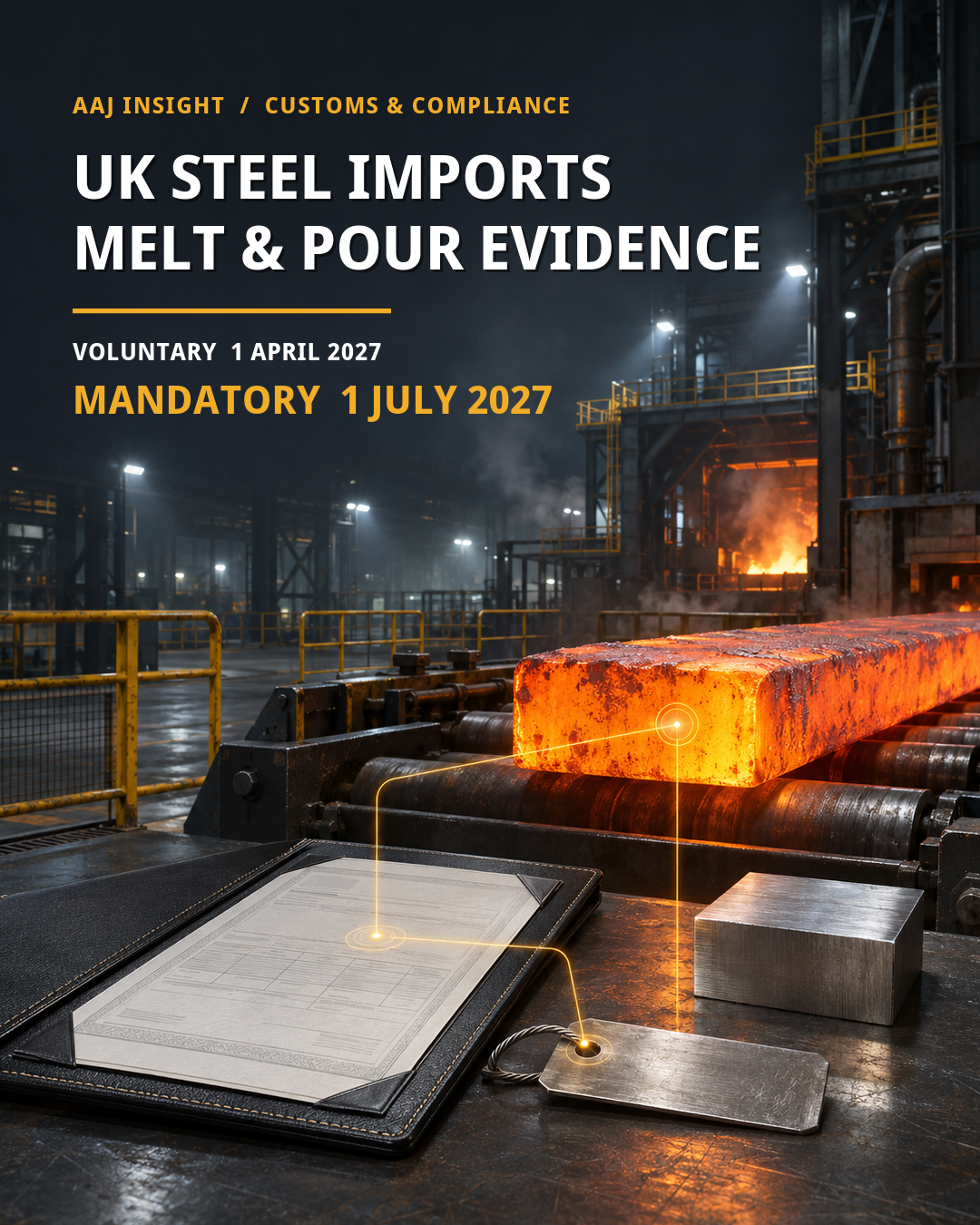
The UK has published a new reporting timetable for certain steel imports. From 1 April 2027, importers will be able to report the country where the steel was first melted and poured through the Customs Declaration Service; from 1 July 2027, reporting becomes mandatory. The requirement is built around a ‘declare and retain’ model: the declaration identifies the melt-and-pour country and the evidence held, while the underlying documents must remain available for HMRC inspection. The practical challenge begins upstream, because country of origin alone is not enough.
Two implementation dates, one evidence chain
The Department for Business, Innovation, Science and Trade published the guidance on 16 November 2026. Reporting is voluntary from 1 April to 30 June 2027 and mandatory from 1 July 2027. Importers that choose to report during the voluntary period must still retain evidence and can be checked through normal customs compliance processes.
The three-month voluntary period is not a waiver for incomplete declarations. It is designed to let businesses test the process and accommodate steel ordered four to six months in advance where historic melt-and-pour information may be difficult to obtain. The safest approach is to treat 1 April as the operational start date and 1 July as the point at which any remaining gaps become compliance failures.
The requirement follows the UK steel trade-measure scope
The reporting obligation applies to steel products within the product scope of the UK steel trade measure. Importers should not build a list from product names alone: the current commodity-code scope must be checked against the official steel measure and the UK Integrated Online Tariff.
Declarations under the same commodity code and country of origin with a value below £2,000 are exempt. The exemption is declaration-specific; it should not be turned into a general assumption about a supplier, product family or annual value. Record why an entry was treated as exempt so the decision can be reconstructed later.
Melt and pour is not the same as origin
The country of melt and pour is where the steel was first melted and poured during the initial steelmaking stage. That country can differ from the country of origin, which reflects where the finished product was last substantially transformed.
A coil, plate, section or downstream steel article may be processed in another country after the original melt. Customs, procurement and freight documents therefore need a separate melt-and-pour field. Copying the declared origin into that field without supporting evidence would defeat the purpose of the requirement and may create an incorrect declaration.
Ask suppliers for the heat-level data now
Government guidance tells businesses to begin requesting melt-and-pour information and supporting evidence immediately, include the requirement in new purchase orders and contracts, agree the process with customs agents, and confirm that internal systems can store the data and documents.
The operational key is the heat test number: the unique identifier assigned by the mill to a batch of steel produced from the same melt. Purchase orders should require the supplier to provide both the melt-and-pour country and the heat number before dispatch, with a clear escalation route where the data is missing or inconsistent.
The mill test certificate is the preferred evidence
A mill test certificate stating the melt-and-pour country and heat test number is the government’s preferred evidence. It is directly issued by the mill and is widely recognised in international steel traceability systems.
The certificate should be linked to the commercial shipment and the declared line item. Importers should test whether certificate identifiers, product dimensions, grade, quantity and heat numbers reconcile with invoices, packing lists and purchase orders. A certificate stored without a reliable link to the imported goods may be difficult to defend during an audit.
Alternative documents remain possible
Where a mill test certificate is unavailable or incomplete, the published list allows invoices, delivery notes, quality certificates, implemented purchase-order or contract clauses, long-term supplier declarations, cost-accounting and production documents, exporting-country customs documents, commercial correspondence and production descriptions.
Alternative evidence must still show the required melt-and-pour country and heat test number. A supplier statement that merely names a country, without the heat-level connection, does not satisfy the published evidence standard. Evidence policies may be adjusted later, so teams should monitor HMRC and departmental updates.
CDS will operate on a declare-and-retain basis
The importer will use CDS document codes to report the melt-and-pour country and the supporting evidence held, then retain the underlying documents for HMRC inspection. Detailed HMRC completion guidance is still due before implementation.
Customs agents and software providers should map the new fields without guessing future codes. Existing CDS practice remains relevant: the commodity code and tariff measures determine the declaration requirements, while Data Element 2/3 is used for documents and other reference codes. Build the data pathway now, but validate the final code set against the HMRC guidance issued closer to launch.
Multiple melt countries need line-level control
A declaration may contain multiple items under the same commodity code and country of origin but with different melt-and-pour countries. The guidance allows importers to select multiple countries, provided they hold appropriate evidence for each.
This makes shipment-level spreadsheets risky if they collapse several heat numbers into one unqualified country. The evidence register should retain the relationship between declaration, line item, supplier, mill, heat number, melt-and-pour country and supporting document.
Northern Ireland remains a separate check
The new Great Britain timetable does not replace melt-and-pour requirements already relevant to certain movements into Northern Ireland under the Windsor Framework. HMRC’s separate Northern Ireland guidance remains in force.
Route and destination therefore matter. Before using a standard operating procedure, identify whether the movement is an import into Great Britain or a goods movement into Northern Ireland and apply the correct tariff, declaration and documentary rules.
Compliance continues after clearance
HMRC may review declarations and evidence through normal customs checks, including post-clearance audits. Incomplete or incorrect declarations may attract standard civil penalties. Voluntary-period declarations are not excluded from these controls.
A workable audit file should contain the declaration reference, commodity code, value, origin, melt-and-pour country, heat number, evidence type, document identifier, supplier and retention location. Controls should also identify entries below £2,000 and record the basis for the exemption.
A practical preparation sequence
First, identify the commodity codes within the steel trade-measure scope and measure current import volumes. Second, amend supplier terms and purchase-order templates so melt-and-pour country and heat number are delivered before shipment. Third, confirm the customs agent’s data requirements and responsibility split. Fourth, test the evidence register against real consignments during the voluntary period.
Do not wait for the mandatory date to discover that a mill certificate cannot be matched to a declaration line. The strongest implementation will connect commercial ordering, mill documentation, freight papers, CDS data and post-clearance records in one traceable chain.
Takeaway
For affected steel imports, origin data will no longer be enough. Build a heat-level evidence chain now, use the voluntary period from 1 April 2027 to test it, and be ready for mandatory CDS reporting from 1 July 2027.
Sources
- Department for Business, Innovation, Science and Trade — Reporting the country of melt and pour for certain steel imports (published 16 November 2026)
- GOV.UK — UK’s steel trade measure from 1 July 2026 (updated 3 November 2026)
- HMRC — Navigate the CDS Declaration Instructions for Imports (updated 12 June 2026)
Practical reading for this route. Check the official guidance for the circumstances of your shipment.