
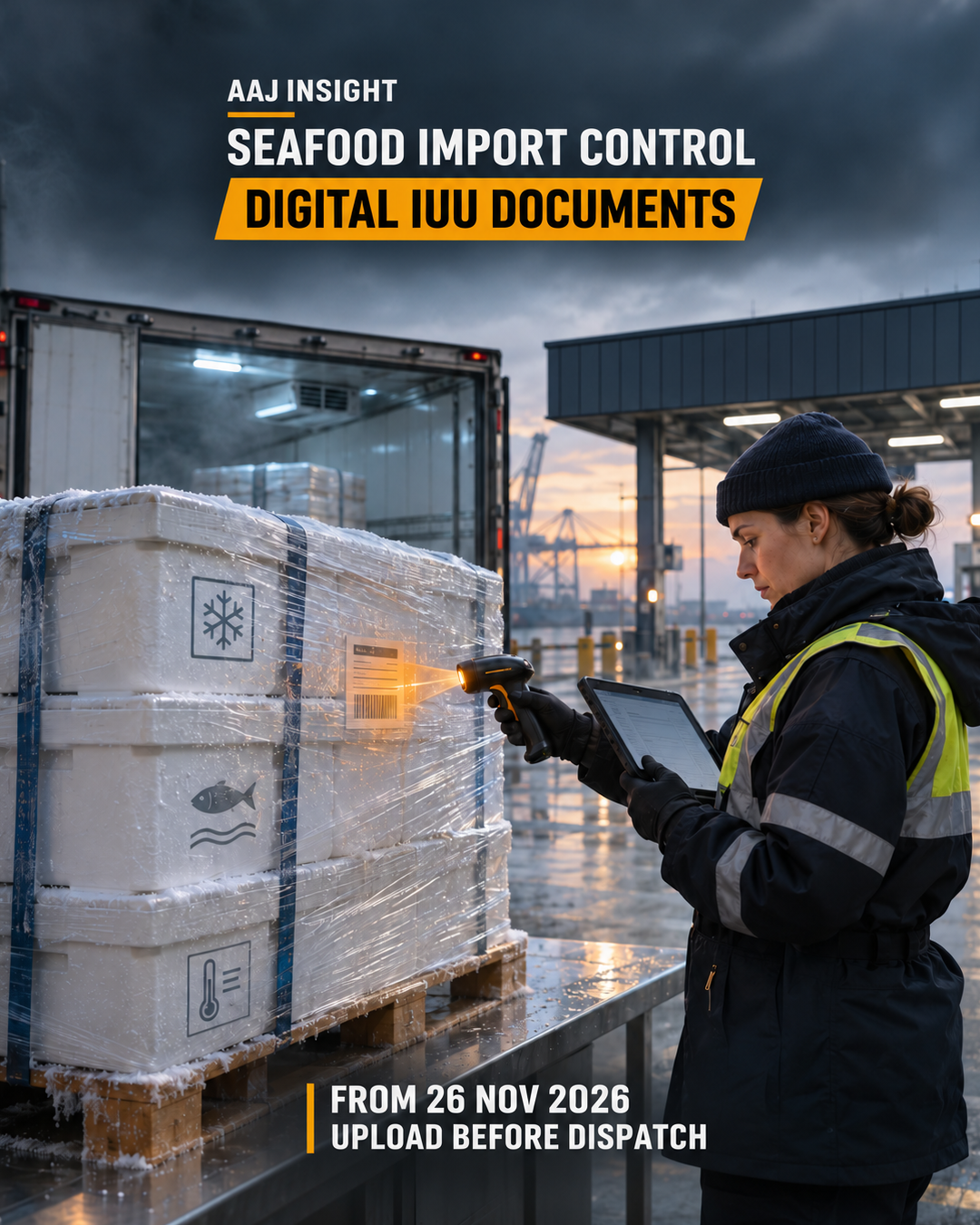
A new digital control applies to UK seafood imports from 26 November 2026. Catch certificates, processing statements and other required information for illegal, unreported and unregulated (IUU) fishing controls must now be uploaded to the UK’s digital import systems. This is not part of the future UK–EU SPS simplification: IUU rules remain a separate border requirement. Importers, agents and freight coordinators therefore need to connect the supplier’s validated documents to the correct IPAFFS notification and port-health submission timetable before the load moves.
What changed on 26 November 2026
The Sea Fisheries (Amendment and Transitional Provision) Regulations 2026 introduced a digital submission requirement for IUU import evidence. The catch certificate, transport details, processing statement and other required information must be uploaded to the United Kingdom’s digital import systems.
Defra’s current sector guidance identifies IPAFFS as the UK digital import system for seafood pre-notifications and IUU documentation. The operational change is therefore not simply to hold a certificate in the shipment file: the required evidence must be connected to the digital import record.
Which documents belong in the IUU file
A catch certificate is the core document for affected wild-caught marine fish and shellfish. Depending on the supply chain, a processing statement and a non-manipulation document may also be required. The non-manipulation document supports traceability where goods pass through or are stored in another country without unauthorised alteration.
The documents should form one auditable chain from vessel and catch through processing, storage, transport and UK import. A freight booking reference alone cannot replace that evidence, and an SPS health certificate does not satisfy the separate IUU requirement.
IUU is separate from SPS and BTOM
The government’s 20 November fish and shellfish guidance explicitly says IUU controls are outside the future Common SPS Area. The UK–EU SPS arrangements planned for 1 March 2028 may remove many routine SPS certificates and checks for eligible goods, but they do not remove IUU controls.
IUU rules also apply regardless of a product’s Border Target Operating Model risk category. A low-risk product may not need an export health certificate, yet an affected wild-caught seafood consignment can still require catch documentation and digital IUU submission.
Who should check the scope
The requirement is relevant to importers and agents handling affected wild-caught marine fish and shellfish, including fishery products and some composite products. Supply-chain teams should identify whether the goods are wild-caught, farmed or exempt before choosing the document route.
Classification and product description should agree across the commercial invoice, catch certificate, health or commercial documents, IPAFFS notification and customs declaration. Species, commodity code, weight and origin data deserve particular attention because mismatches can delay documentary clearance.
Build the IPAFFS record before the vehicle moves
For most freight imports of fish and fishery products into Great Britain, the importer must submit an IPAFFS notification, upload the applicable IUU documents and enter the required information from those documents into the system. If the relevant port or local authority uses PHILIS, the same IUU documents may also need to be uploaded there.
Agree responsibility in writing before dispatch: who creates the IPAFFS notification, who receives the validated supplier documents, who checks the reference and who monitors messages from the border authority. The haulier should receive the routing and inspection instruction, not be expected to repair missing certification at the port.
The advance-submission clock still matters
Current government guidance states that required IUU documents must reach the relevant port health authority 72 hours before arrival by sea, four hours before arrival by rail or air and two hours before arrival by road.
Those are minimum operational deadlines, not a target for receiving supplier evidence. Importers should collect and validate documents earlier so corrections can be made without risking the booking, temperature control or delivery slot.
Old-format documents have a defined transition
The regulations contain a specific transitional rule. Catch certificates and related documents validated, endorsed or signed before 26 November 2026 under the previous requirements may continue to be accepted until 10 January 2028.
That transition depends on the document’s validation, endorsement or signature date—not merely the purchase order, sailing or arrival date. Keep that date visible in the import file and avoid recreating an older valid document in a way that obscures its status.
Keep customs, SPS and IUU references aligned
A seafood import can involve three different control tracks: customs clearance, SPS or food-safety controls, and IUU fisheries documentation. Each has its own data, system and decision point, but the shipment identifiers, weights, product descriptions and transport details must remain consistent.
A practical control sheet should link the customs declaration reference, IPAFFS notification, catch certificate number, processing or non-manipulation document, health certificate where required, port-health submission and the haulier’s booking reference.
Plan for documentary and physical checks
Government guidance says all affected goods are subject to documentary checks at entry, while some will also be selected for identity or physical checks for IUU and SPS purposes. Port-health fees may apply and vary by authority.
The transport plan should therefore include the correct designated point of entry, realistic clearance time, temperature-control continuity, a named contact for document queries and a contingency if the consignment is called for inspection.
A practical dispatch gate
Before releasing the load, confirm the product is correctly scoped; the catch certificate is validated; any processing or non-manipulation document is present; the IPAFFS record contains the required uploads and data; any PHILIS submission is complete; advance deadlines are met; and all weights, species, codes and transport details reconcile.
The safest rule is simple: no validated document chain, no dispatch. Digital submission makes the evidence visible to the authority earlier, but it does not cure incomplete or inconsistent source documents.
Takeaway
From 26 November 2026, required IUU evidence is a digital border control, not just paperwork carried with the load. Link the validated catch-document chain to IPAFFS before dispatch, meet the port-health deadline and keep customs, SPS and IUU data consistent.
Sources
- Defra and APHA — Fish and shellfish changes: preparing your business (published 20 November 2026)
- UK Government — Importing or moving fish to the UK (IUU requirements changed 26 November 2026)
- UK legislation — The Sea Fisheries (Amendment and Transitional Provision) Regulations 2026
Practical reading for this route. Check the official guidance for the circumstances of your shipment.