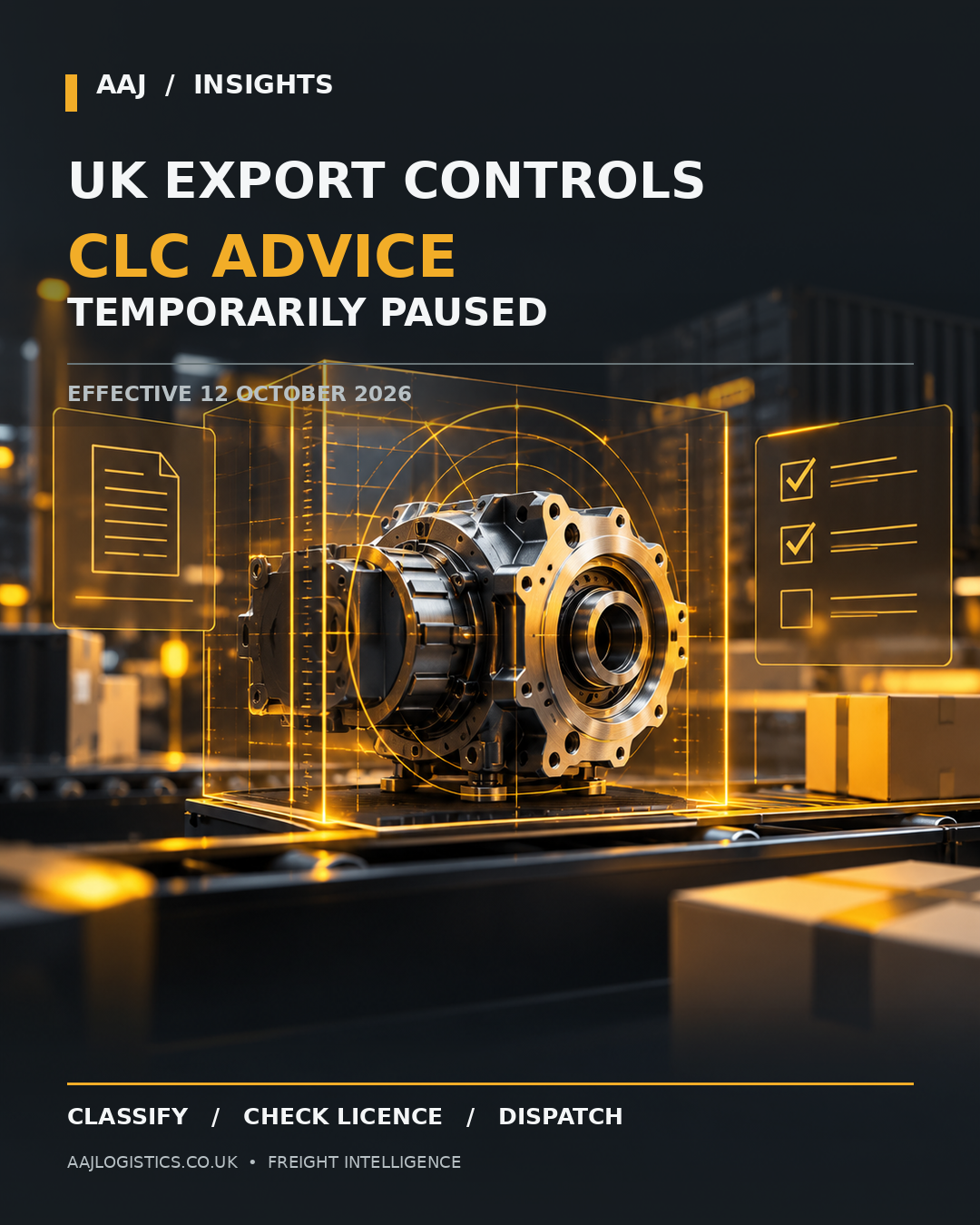
A booking can be ready for collection while its export-control position is not. On 12 October 2026, the UK's Export Control Joint Unit (ECJU) paused its Control List Classification (CLC) advisory service so staff can prioritise export licence applications. The pause changes access to a government advisory channel—not the legal requirement to classify goods, assess end-use and obtain a required licence before export. For freight forwarders, the safest operational response is a documented handover between the exporter, licensing specialist and dispatch team.
What ECJU changed on 12 October
Notice to Exporters 2026/22 says the Control List Classification service was paused from Monday 12 October 2026. ECJU requested that exporters refrain from submitting new CLC advisory requests during the pause because they will not be processed. The department attributed the change to pressure on resources while handling increasingly complex export-licence applications.
Requests received before 12 October will continue to be processed, though responses may take longer than usual. ECJU has promised a progress update before the end of 2026; the notice does not set a firm restart date. Crucially, this is an advisory-service pause, not a blanket suspension of export licences or a general prohibition on shipments.
Classification remains the exporter's responsibility
The UK strategic export-control framework places responsibility on the exporter to establish whether an item, software or technology is controlled and whether a licence is required. Classification begins with the UK consolidated military and dual-use control lists and relevant goods-checking tools, but end-use controls and sanctions can create additional obligations even if an item is not expressly listed.
The government cautions that exporting controlled items without the appropriate licence is a criminal offence. A logistics provider should therefore avoid treating the commercial invoice description or customs commodity code as a complete substitute for export-control classification. The exporter or its authorised compliance adviser needs to confirm the applicable control-list entry, end-user, destination, end-use and licence basis.
The freight-booking handover needs four confirmations
First, identify the classification owner: who has checked the technical specification against the current control lists, and where is their written decision? Second, confirm destination, consignee and ultimate end-user, including any sanctions or end-use concerns. Third, determine whether a valid licence or appropriately registered open general export licence covers this specific combination of items and destination. Fourth, agree who will supply the reference, terms and declarations to the customs and transport teams before the vehicle is released.
If an exporter has not determined whether a licence is required, the absence of a CLC response is not clearance to ship. Treat the booking as conditional while the relevant expert makes a defensible assessment. Preserve correspondence, product specifications, licence evidence and decision records alongside the shipment file.
New OGEL coverage does not remove the need to check eligibility
A separate ECJU notice dated 14 October 2026 expanded the destination coverage of certain dual-use and military goods, software and technology open general export licences. That could simplify some eligible exports, but it is not a universal authorisation for all sensitive goods and routes. It is necessary to check the precise licence text, product scope, end-user category, destination, registration requirements and conditions.
For example, the new dual-use OGEL destination expansion includes Bahrain, Jordan, Kuwait, Morocco, Oman, the Philippines and Qatar, among others. This is a useful reminder that country eligibility is licence-specific. Do not transpose a permitted destination from one OGEL to a different licence or assume a commercial product is automatically outside export controls.
Operational action for consignments moving this week
Before confirming a collection slot for equipment, components, technology-bearing products or other potentially controlled cargo, ask whether export classification is complete and documented. Flag uncertain shipments early to the exporter and its compliance team. Ask for the appropriate licence reference and any conditions that affect routing, destination or customs declarations; match the information across the shipping instructions and other documents.
Keep transport, customs and export-control roles separate. A forwarder can operate a robust dispatch-control checkpoint without pretending to determine regulatory classification for the exporter. Check the ECJU notice for updates—the government has not announced a reopening date for CLC advice as of this 20 October review.
Takeaway
The CLC advisory-service pause does not waive export controls. Before dispatch, confirm the exporter's classification, destination and end-user screening, applicable licence and document owner; escalate unresolved cases rather than assuming they are cleared.
Sources
- ECJU Notice to Exporters 2026/22 — CLC pause (12 October 2026)
- GOV.UK — UK strategic export controls (updated 23 April 2026)
- ECJU Notice to Exporters 2026/23 — OGEL expansion (14 October 2026)
Practical reading for this route. Check the official guidance for the circumstances of your shipment.