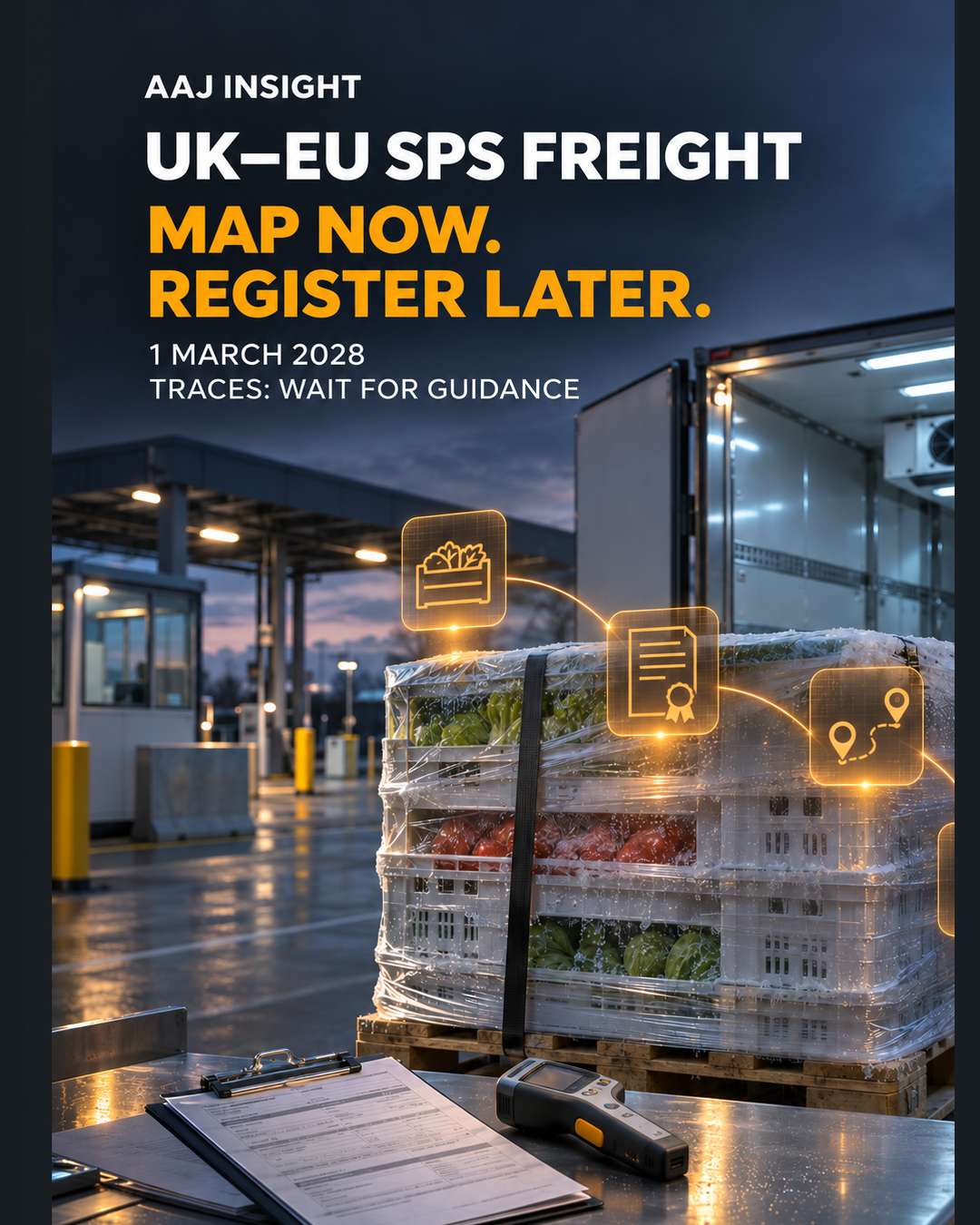
Defra published a new set of SPS Agreement guidance on 20 November 2026 for logistics providers, hauliers, customs agents, importers and exporters. The planned application date is 1 March 2028, subject to UK and EU procedures and limited transition arrangements. Until then, the operational instruction is deliberately conservative: continue using existing processes and systems, and do not register or reactivate a TRACES account for the future arrangements until government guidance says to do so.
What was announced on 20 November 2026
Defra and the Animal and Plant Health Agency published initial operational guidance on how the UK–EU SPS Agreement is expected to affect food and feed, plants, live animals and other agrifood goods. Separate guidance addresses logistics and haulage, digital systems, and the import and export requirements that are still being developed.
The Agreement is planned to apply from 1 March 2028, subject to UK and EU procedures, with targeted transition arrangements in limited areas. It is therefore a future operating model, not a change that freight teams should apply to consignments moving today.
Existing border processes remain in force
Before 1 March 2028, businesses must continue to follow existing commodity and route requirements, including current Border Target Operating Model processes and controls where applicable. Importers into Great Britain should continue using IPAFFS, while exporters should continue using the systems required for their goods, including EHC Online, PHES and the Fish Export Service where relevant.
A future reduction in SPS paperwork or inspections must not be applied early. Bookings, pre-notifications, certification and border presentation should continue to follow the rules in force on the date of movement.
Do not create or reactivate a TRACES account yet
The digital-systems guidance is explicit that no action is required at this stage. Businesses should not register for a new TRACES account, or reactivate an old account for the future arrangements, until they are advised to do so.
Premature registration can cause account set-up problems and later delays. A useful readiness action now is to identify the people and teams likely to need access, without submitting registrations or inventing a future workflow before the detailed onboarding model is published.
Customs and SPS remain separate controls
HMRC customs clearance requirements remain separate from SPS requirements and will continue to apply under the Agreement. Fewer SPS declarations or physical inspections will not remove customs declarations, rules-of-origin obligations, transit procedures or other customs controls.
A future process map should therefore keep two visible tracks: the customs movement and the SPS movement. The handoff between them matters, but completion of one does not automatically complete the other.
GB–EU freight is expected to become simpler
For eligible trade between Great Britain and the EU, the guidance anticipates the removal of the vast majority of routine SPS certification, pre-notification and border checks. Defra expects significantly fewer physical SPS inspections and smoother movement for fresh and chilled goods.
The detail will still depend on the commodity and any pest, disease, certification or other exceptions. Logistics planners should treat the expected simplification as a design direction, not as authority to remove a current document or control.
Non-EU imports may require more preparation
Great Britain is expected to align with the EU approach to SPS imports from third countries. Some non-EU consignments may face different or additional certification, documentation, establishment-eligibility, pre-notification or inspection requirements compared with the current GB model.
This means the same Agreement can reduce friction on one lane while adding work on another. Freight teams should separate GB–EU movements from rest-of-world imports in their readiness analysis instead of assuming a single benefit or burden across the whole network.
Build a commodity-and-route impact matrix
Start with the goods actually moved: commodity description and code, animal or plant content, country of origin, establishment, intended use, temperature regime and current certification. Add the origin, transit points, first point of entry, destination and any transhipment.
For each movement, record the current SPS system, declaration or certificate, border facility, responsible party and customs procedure. Add a future-state column marked confirmed, expected or awaiting guidance. This keeps published facts separate from assumptions.
Revisit mixed loads, transit and transhipment
Defra expects the future arrangements to make consolidation of mixed SPS and non-SPS loads easier in some GB–EU trade. However, detailed guidance on trade journeys, transits, transhipments and digital requirements is due during 2027.
Do not redesign a groupage or consolidation process solely from the headline. Map which consignments share equipment, documents and border events, then wait for confirmed commodity and journey rules before changing loading instructions or service promises.
Prepare for data matching, not just new software
The guidance highlights the importance of matching SPS notification and customs declaration data. Relevant references, commodity codes, weights or quantities must be consistent; mismatches can place goods on customs hold until resolved.
Readiness should therefore include data ownership and validation. Decide who creates the SPS record, who prepares the customs entry, which source supplies the commodity and quantity data, and who resolves an exception before the vehicle reaches the border.
Use the 2027 guidance timetable as decision gates
Government says further digital guidance will be published in spring and throughout 2027, including which goods and movements will use TRACES and who will be affected. Later guidance is expected to cover transition timelines, certification, notification, data arrangements and training.
Create review gates against those publications. Until a requirement is confirmed, keep the item in an assumptions register rather than purchasing software, changing contracts or promising customers a specific future border process.
What logistics teams should do now
Map affected commodities and routes, identify the parties responsible for certification, SPS notifications, customs entries and border presentation, and document which current systems are used. Discuss the future change with suppliers, customers, hauliers, customs agents, ports and certification bodies.
Keep operating under current rules. Monitor Defra updates, preserve a change log and turn each confirmed future requirement into a controlled implementation task. Do not register for TRACES until the government publishes the onboarding instruction.
Takeaway
Prepare the data, roles and route map now—not the future account. The SPS Agreement is planned for 1 March 2028, current processes continue, customs remains separate, and TRACES registration should wait for formal guidance.
Sources
- Defra — Logistics, hauliers and trade intermediaries: preparing your business for changes (published 20 November 2026)
- Defra and APHA — Changes to digital systems for trading SPS goods (published 20 November 2026)
- Defra and APHA — Changes to importing and exporting food, animals and plants (published 20 November 2026)
Practical reading for this route. Check the official guidance for the circumstances of your shipment.