A potential customs-cost change is now visible for UK imports of certain tracked excavators from China, but it has not yet taken legal effect. On 20 November 2026, the Trade Remedies Authority (TRA) published initial findings proposing higher anti-dumping duties for most exporters after concluding that the existing measure may have been absorbed. For freight, procurement and customs teams, the practical response is to identify affected purchase orders, model the possible landed-cost increase and preserve the correct current treatment until a final recommendation and ministerial decision are published.
What changed on 20 November 2026
The TRA published its initial findings in case AR0089, the UK’s first absorption review. It proposes increasing the anti-dumping duties on imports of certain excavators from China because the authority’s initial analysis indicates that the existing duties may have been absorbed rather than passed through into UK resale prices.
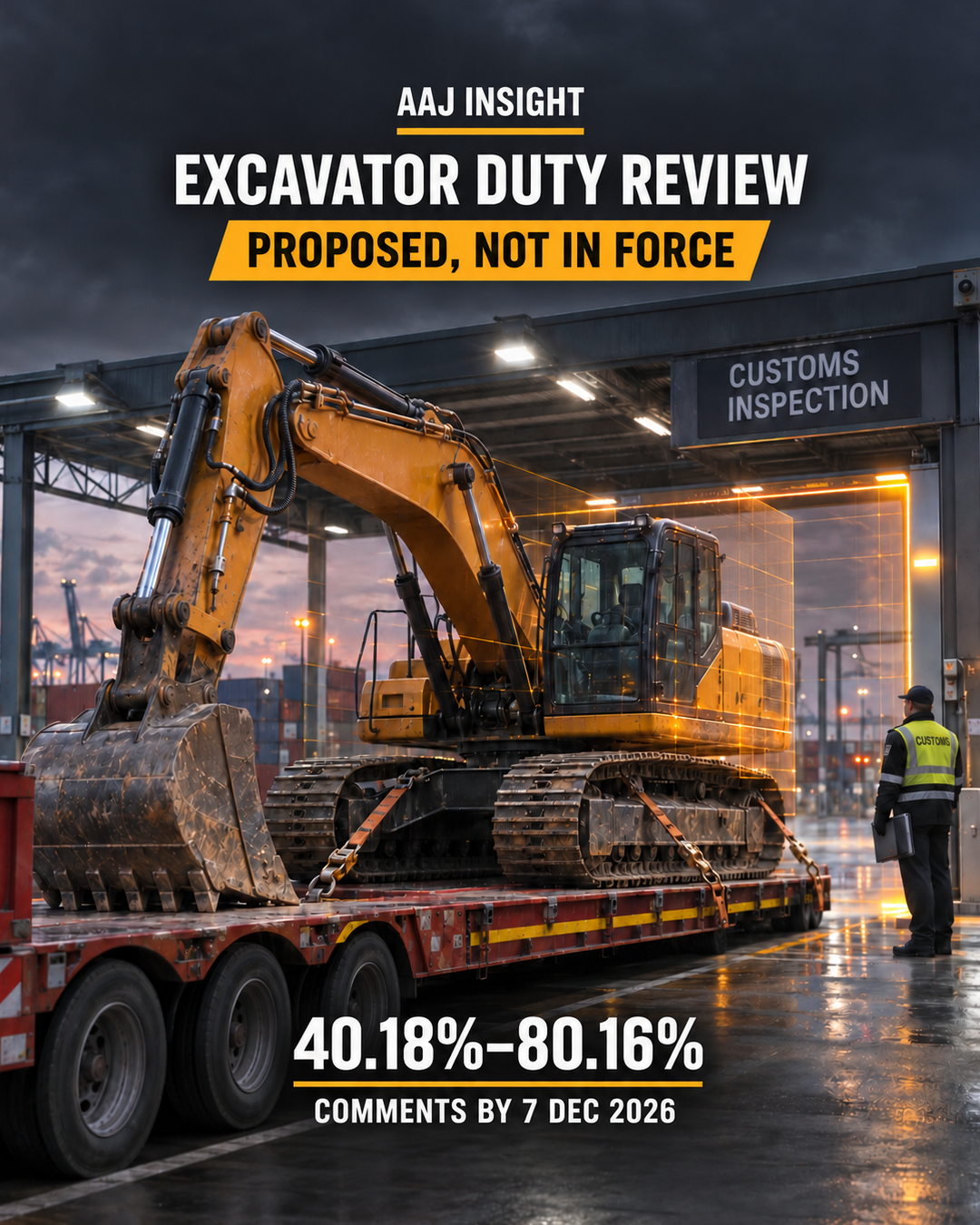
The proposed anti-dumping rates for exporters other than Caterpillar Group range from 40.18% to 80.16%. For Caterpillar Group, the TRA says it found no evidence of absorption because of the group’s current lack of exports to the UK from China, and it intends to recommend maintaining the current applicable duty.
This is a proposal, not a new rate in force
The 20 November publication is a Statement of Essential Facts and an invitation to comment. It is not a public notice imposing new duty. Interested parties can comment through the TRA public file before 7 December 2026.
After considering comments, the TRA may make a final recommendation to the Secretary of State. The Secretary of State can accept or reject that recommendation, ask for reassessment or take a different decision where the statutory process permits. Until a later legal notice says otherwise, import declarations should continue to use the rates and requirements currently in force.
Which machines are within the published scope
The review concerns self-propelled, track-laying excavators with a 360-degree revolving superstructure and an operating weight of at least 11,000 kg but less than 80,000 kg. Country of origin is China; the shipping country alone does not determine origin.
A product description such as “construction machinery” is not enough for a customs decision. Importers should retain the model specification, operating weight, propulsion and undercarriage details, superstructure description, manufacturer identity, origin evidence and the commodity classification used on the declaration.
What applies today
The definitive UK measures accepted in May 2025 currently include anti-dumping duties ranging from 18.81% for a sampled exporter to a 40.08% residual rate. Separate countervailing duties range from 0% to 2.98%. The new initial findings concern the anti-dumping element; they do not announce a replacement countervailing schedule.
That distinction matters when reviewing a customs entry or landed-cost model. Teams should identify each component of the current trade-remedy treatment and avoid replacing the live rate with a headline proposed percentage.
Build a shipment-level exposure register
Start with open purchase orders, goods already in production, units in transit and planned arrivals after the consultation period. For each machine, record the manufacturer and exporter, origin, model, operating weight, commodity code, current anti-dumping and countervailing treatment, incoterm, customs value and expected UK arrival date.
Then calculate scenarios using the published proposed anti-dumping range of 40.18% to 80.16%, while clearly labelling those calculations as planning assumptions rather than declaration instructions. This identifies which orders may need commercial review without contaminating current customs data.
Exporter identity can change the result
Trade-remedy rates can depend on the overseas producer or exporter and the additional code used in the declaration. A brand name on the machine, a trading company on the invoice and the actual producer are not automatically interchangeable.
Customs teams should reconcile the sales invoice, manufacturer documentation, origin evidence and the entity linked to the applicable rate. Where the supply chain includes a distributor or a third-country seller, confirm the producer and Chinese origin before finalising the entry.
Keep freight decisions separate from customs assumptions
Transport bookings, port handling and delivery planning may need to continue while the review is open. Freight teams can support the response by linking each booking reference and arrival forecast to the exposure register, but they should not instruct a broker to apply a proposed rate.
If the possible duty change affects financing, stock release or customer pricing, agree a documented internal trigger: for example, publication of the final recommendation or the legal notice that specifies an effective date. That prevents a consultation-stage headline from becoming an unsupported customs instruction.
If your business has evidence, the deadline matters
The TRA has invited interested parties to comment on its initial findings before 7 December 2026. Businesses considering a submission should work through the official case file and provide relevant, supportable evidence rather than relying on a general commercial objection.
The review process allows the TRA to consider comments before its final recommendation. A company that may be directly affected should therefore coordinate customs, finance, procurement and legal input early enough to meet the official filing requirements.
A practical control list for importers
Confirm whether each machine matches the technical scope; verify Chinese origin and the producer-exporter chain; check the live commodity and additional codes with the customs declarant; retain the current rate on today’s entries; model the proposed rates separately; review contracts and incoterms for who bears import charges; and monitor the official public file for the final outcome.
The most important control is version discipline. Mark every calculation and instruction with its source date, case number and status—current measure, initial finding, final recommendation or legal notice—so operational teams do not treat different stages as interchangeable.
What to watch next
The next meaningful milestones are the close of comments on 7 December 2026, any final recommendation from the TRA and the Secretary of State’s subsequent decision. A changed duty becomes operational only when the appropriate legal instrument specifies the applicable rates and effective date.
Until then, the useful work is preparation: clean product and supplier data, shipment-level visibility, scenario modelling and a controlled route for updating brokers when an official change actually occurs.
Takeaway
Treat the 40.18% to 80.16% figures as exposure scenarios, not customs instructions. Keep using the current legally applicable duties, identify machines within the 11-to-under-80-tonne scope, verify the producer-exporter chain and monitor the official case through the 7 December consultation and subsequent decision.
Sources
- Trade Remedies Authority — TRA proposes increasing anti-dumping measure on excavators (published 20 November 2026)
- Trade Remedies Authority — TRA recommendation for new duties on Chinese excavators accepted (published 15 May 2025)
- Trade Remedies Authority — Reviews of anti-dumping and countervailing measures (updated 21 August 2026)
Practical reading for this route. Check the official guidance for the circumstances of your shipment.