
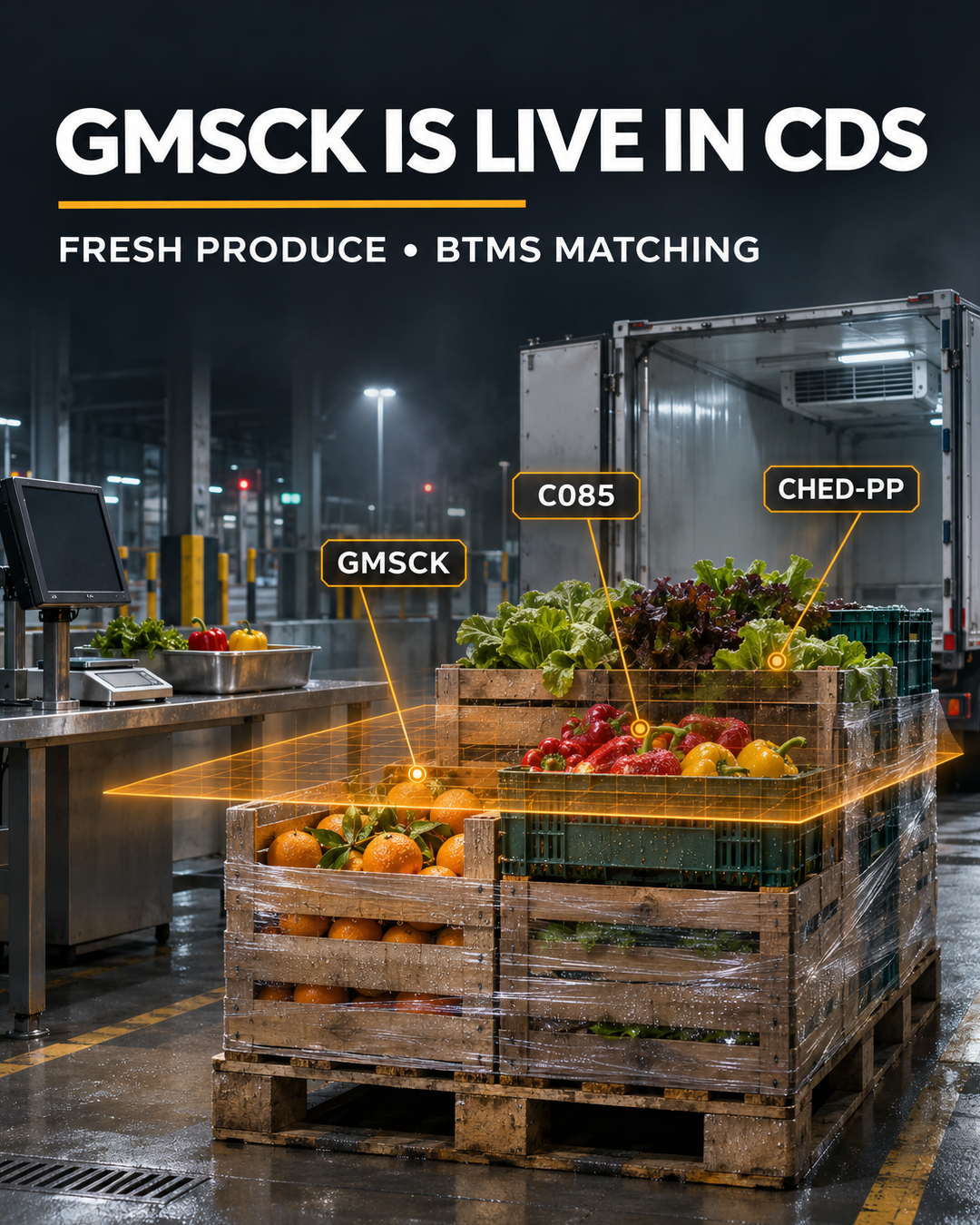
A small customs-code change can decide whether a perishable consignment moves or waits. On 26 November 2026, HM Revenue & Customs confirmed that additional information code GMSCK has been integrated into the Customs Declaration Service GB Tariff. When General Marketing Standards goods are selected for inspection, the importer or declarant should make the corresponding IPAFFS notification and amend the customs declaration with both GMSCK and the related CHED-PP reference. The change is already operational; it is not a future SPS milestone.
What changed on 26 November 2026
HMRC updated its guidance for sanitary and phytosanitary controlled imports to confirm that additional information code GMSCK is now integrated into the Customs Declaration Service GB Tariff. The instruction applies when horticultural goods covered by General Marketing Standards are selected for inspection.
For a selected consignment, the customs declaration should be amended at item level to include GMSCK in data element 2/2. The same amendment also needs the General Marketing Standards-related CHED-PP identifier, associated with document code C085, in data element 2/3. HMRC describes this as a current process, so traders should treat it as effective now rather than as an announced future change.
Why the update matters to perishable freight
General Marketing Standards cover most fresh fruit, vegetables, nuts, herbs and cultivated mushrooms. The Horticultural Marketing Inspectorate selects a proportion of Great Britain-destined goods for checks. When a product is selected, the Border Trade Matching Service can return a GMS ‘no match’ message until the required notification and customs data are aligned.
That turns a data-quality issue into a physical-flow issue. Fresh produce has limited tolerance for dwell time, so a missing code or an incorrectly formatted CHED reference can create disproportionate cost and disruption even when the underlying goods are compliant.
The correct response to a GMS no-match
First, make the required General Marketing Standards pre-notification in IPAFFS. Then amend the relevant customs-declaration item to add GMSCK in data element 2/2 and enter the related CHED-PP identifier against document code C085 in data element 2/3.
The order matters operationally because BTMS must be able to find a live Defra pre-notification and match it to the customs declaration. Adding a document code without the supporting notification can itself produce an X00 no-match.
Format the CHED-PP reference for CDS, not IPAFFS
IPAFFS and CDS display the same underlying CHED reference differently. HMRC’s customs format is GBCHDyyyy.nnnnnnn: the prefix GBCHD, the four-digit notification year followed by a full stop, and the seven-digit number generated by IPAFFS.
For example, an IPAFFS-style reference such as CHEDPP.GB.2026.1234567 is represented on the customs declaration as GBCHD2026.1234567. The reference belongs in data element 2/3 with C085 for a CHED-PP. Copying the IPAFFS presentation into CDS without conversion can prevent the automated match.
Three data points BTMS attempts to match
BTMS looks for the Defra pre-notification and attempts to match the CHED identifier in data element 2/3, the net weight in data element 6/1 or number of live animals in data element 6/2, and the commodity code in data elements 6/14 and 6/15.
For produce movements, that means the customs and IPAFFS teams need one agreed dataset before either filing begins. The CHED reference, relevant commodity classification and net weight should be checked as a single control set, not as separate clerical fields owned by different parties.
Do not declare unnecessary BTMS document codes
HMRC warns that CDS Tariff validation accepts additional document codes only where the relevant documentary requirements apply. Declaring a BTMS document code that the Tariff does not require, without a supporting Defra pre-notification, can trigger an X00 no-match.
The practical rule is to test the commodity code and measure in the current UK Trade Tariff for each item. Do not carry documentary assumptions forward simply because a similar product or earlier shipment needed a health or marketing-control document.
Use GMSPR when goods are genuinely for processing
Where a General Marketing Standards product is prepared, processed or intended for industrial processing, HMRC says additional information code GMSPR should be declared in data element 2/2 at item level. This indicates that the Horticultural Marketing Inspectorate’s General Marketing Standards do not apply.
GMSPR is not a substitute for GMSCK. The former describes an applicable processing exemption; the latter is the response when an in-scope consignment has been selected for inspection. Using GMSPR without a genuine processing basis would misstate the movement.
Correct mismatches before escalation
An X00 message identifies the data element that did not match. If the error is in IPAFFS, amend the existing pre-notification or delete it and submit a replacement. If it is in CDS, amend the declaration; where the software does not support amendment, cancel and resubmit it.
BTMS will run the matching process again. If the data aligns, it can send a decision notification to CDS. If it does not, CDS will not receive that decision and the customs declaration will not clear. Manual release is a fallback for eligible goods when automated release still fails after the notification, declaration and no-match responses have been completed—not a replacement for correcting avoidable data errors.
Build a pre-arrival matching control
A useful shipment-level check should record the declarant, IPAFFS notifier and carrier contact; the exact commodity code; the applicable document and additional-information codes; net weight; the IPAFFS reference; its converted CDS format; and the person responsible for monitoring CDS responses.
The check should be completed before arrival and repeated after any commercial change. Weight adjustments, split consignments and late product substitutions can break a match even when the first filing was accurate. HMRC confirms that BTMS can handle multiple CHEDs on one declaration, one CHED across several declarations, and multiple CHEDs across multiple declarations, but every relationship must still be represented consistently.
What importers should do now
Update customs work instructions and broker templates so that GMSCK is available for selected General Marketing Standards goods. Confirm that staff know it belongs in data element 2/2 and that the related C085/CHED-PP identifier belongs in data element 2/3.
Finally, retain the CDS acceptance messages, IPAFFS notification and inspection outcome together. That evidence makes it easier to diagnose a repeat mismatch and to show that the declaration was amended in response to the selection rather than filed with a speculative inspection code.
Takeaway
From 26 November 2026, a General Marketing Standards inspection selection requires a joined-up response: create the IPAFFS notification, add GMSCK in CDS data element 2/2, add the related C085/CHED-PP reference in data element 2/3, and check the CHED identifier, commodity code and weight as one matching set before expecting BTMS clearance.
Sources
- HM Revenue & Customs — Importing SPS controlled goods that interact with the Border Trade Matching Service (updated 26 November 2026)
- Defra and APHA — Import of products, animals, food and feed system (IPAFFS) (updated 17 September 2026)
- HM Revenue & Customs — Apply for a manual release of certain plant, animal and food products (updated 15 October 2025)
- Cabinet Office — Technical questions and answers about Sanitary and Phytosanitary Controls: matching CHED, commodity code and net weight
Practical reading for this route. Check the official guidance for the circumstances of your shipment.