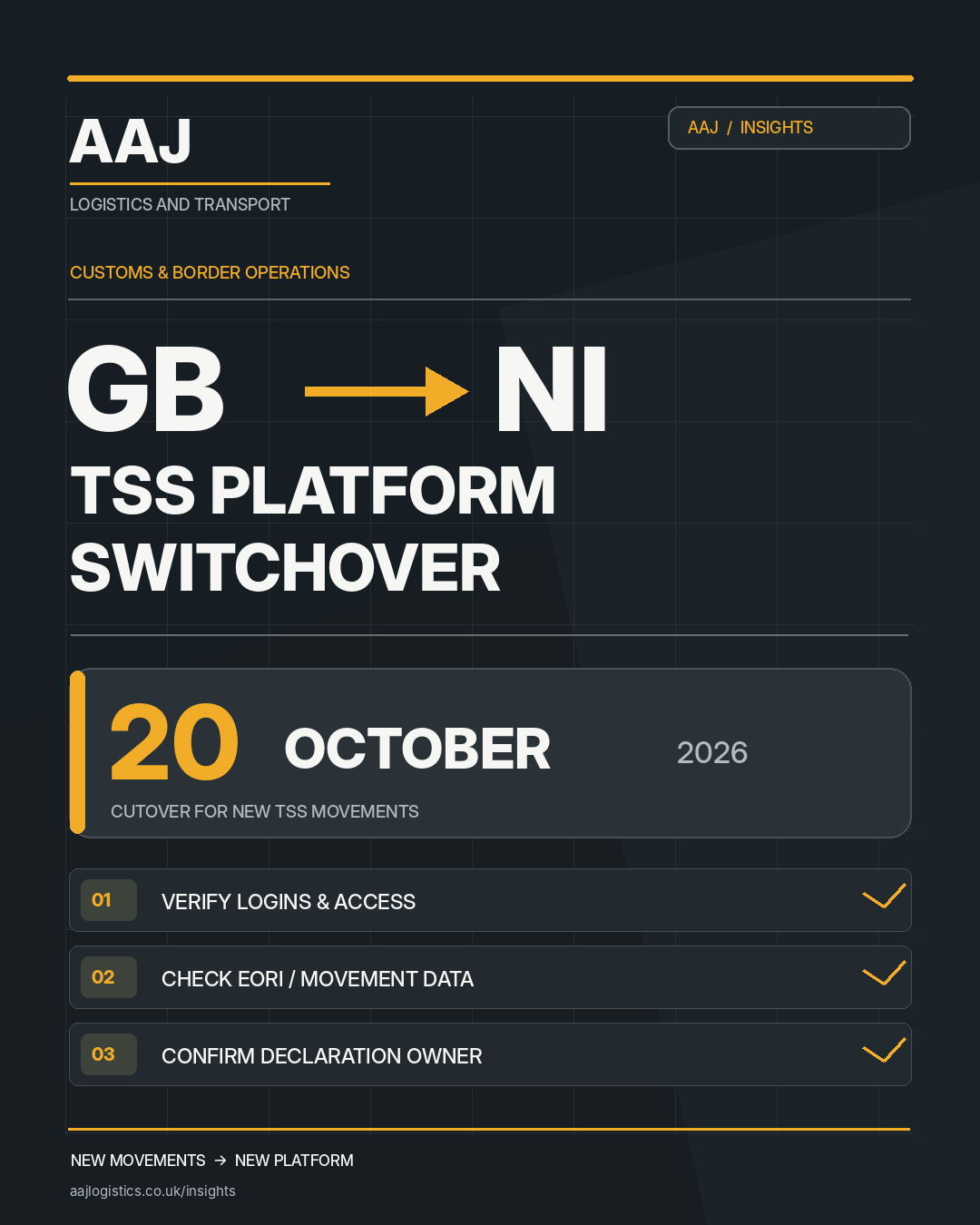
Businesses using the Trader Support Service (TSS) for Great Britain–Northern Ireland movements face an imminent system cutover. HM Revenue & Customs says all new movements from 20 October 2026 must be submitted on the new TSS platform, while the outgoing service will no longer accept them. This is an access and workflow change, not a newly announced customs-duty or eligibility rule. For a booking team, the immediate question is whether the right people can log in, prepare declarations and resolve exceptions before collection.
20 October is a submission cutover for TSS users
HMRC’s 22 September notice says all goods movements taking place on or after 20 October 2026 must be submitted through the new Trader Support Service platform; the outgoing TSS will not accept new movements from that date. HMRC updated its core guidance on 14 October, confirming that all new movements from 20 October must use the replacement service.
This requirement concerns businesses that use TSS to support customs and safety-and-security declarations for movements between Great Britain and Northern Ireland. It does not mean that every business shipment must use TSS, nor does a new website by itself change customs responsibilities or the Windsor Framework. HMRC says the underlying legal and regulatory obligations remain the same.
Existing accounts are migrated, but access still needs checking
HMRC says businesses already signed up for the outgoing TSS will be migrated and do not need to register again. Users were advised to look out for email instructions and complete pre-enrolment; HMRC also says businesses will need to create a new password and check their details and permissions. Updating a profile can take around 5–30 minutes depending on the account and available information.
A successful migration record is not the same as a working operational login. Before the cutover, check who holds the account administration role, who prepares movement details, which staff or customs agents need access, and whether they have completed the new sign-in process. Use HMRC or the official TSS access route rather than links forwarded by unknown senders.
New applicants should check the EORI and authorised users
HMRC’s new registration guidance, published 14 October, says an eligible business moving goods between Great Britain and Northern Ireland needs an EORI number. The guidance lists GB, XI and certain other EORI types that may be used for registration. New users need personal and business details. If a company already has an account, an administrator must invite an additional user rather than have them create a duplicate business registration.
The service may also record relevant customs authorisations, such as simplified declarations, entry in declarant’s records, duty deferment or warehousing permissions where the business has them. Do not assume these are universal prerequisites. Check only the authorisations relevant to the movement and declaration procedure.
Treat the switchover as a dispatch control
For collections planned around 20 October, confirm the declaration owner and the party actually submitting via TSS. Match collection references, dispatch and arrival dates, consignment details and movement status across the haulier, trader and customs representative. Agree who can correct a rejected or incomplete declaration and who tells the driver whether the load is ready to move.
If a collection is due during the transition, avoid assuming an old draft or saved workflow will transfer perfectly. Confirm the applicable process with TSS, retain the movement reference and proof of submission, and do not release a vehicle against an unverified customs instruction. This is an operational risk check, not a claim of a scheduled border closure.
Three checks to complete before the deadline
First, verify account access: sign-in, password reset, administrator and team permissions. Second, verify data: the business EORI, goods descriptions, movement particulars and relevant supporting paperwork. Third, verify escalation: record the TSS contact route, name the person who can resolve login or declaration errors, and communicate the fallback plan to the loading and transport desks.
HMRC lists a TSS helpline on 0800 870 8173, operating 8:00am–5:30pm, seven days a week. If your business uses a customs intermediary or a separate declaration service, confirm its cutover arrangements directly. What matters on 20 October is that each movement has a working authorised submission route before dispatch.
Takeaway
For GB–Northern Ireland movements submitted through TSS, 20 October is a platform switch rather than a new customs law. Verify migrated logins, EORI, user permissions and the declaration owner before the truck is dispatched.
Sources
- HMRC — Sign up for the Trader Support Service (updated 14 October 2026)
- HMRC — Register to declare goods moving to or from Northern Ireland using TSS (published 14 October 2026)
- HMRC — Trader Support Service users urged to prepare for new platform (22 September 2026)
Practical reading for this route. Check the official guidance for the circumstances of your shipment.