
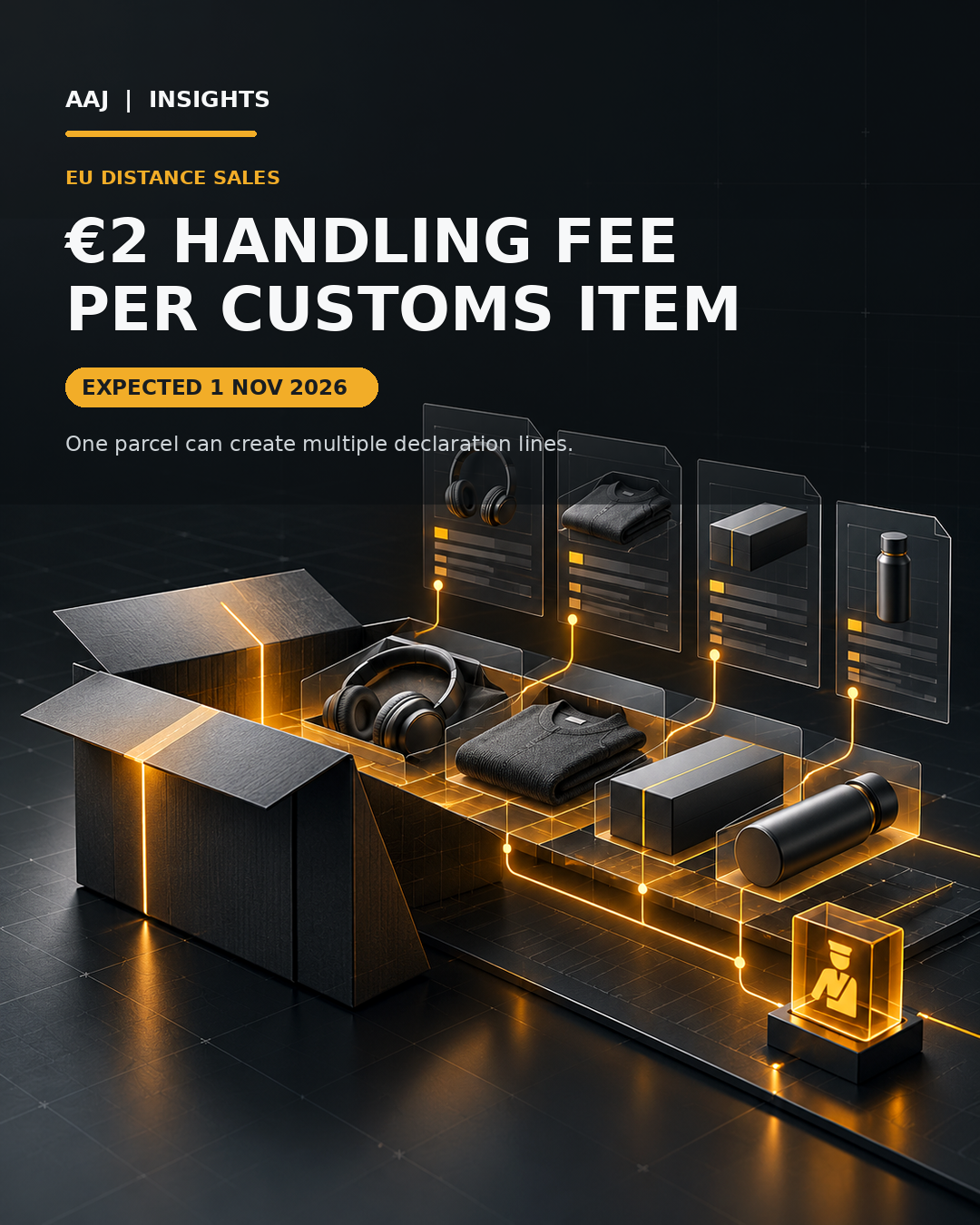
A new cost is approaching for goods sold online from Great Britain into the EU. The European Commission says a €2 Union handling fee will apply to distance-sale goods from 1 November 2026. The practical detail matters: the fee is fixed per customs item, not as one charge for every physical parcel.
An expected November start, not a July change
The European Commission’s customs reform page, updated on 7 October 2026, says the €2 Union handling fee will apply from 1 November 2026. The detailed guidance is dated 5 October and describes the start as expected from 1 November because the relevant delegated act remains under scrutiny. Businesses should prepare for that date while continuing to check the final legal position and any national customs instructions.
This is separate from the temporary €3 customs duty introduced on 1 July 2026 for relevant low-value distance-sale goods in consignments up to €150. The handling fee and the temporary duty are different charges with different scope.
The €2 fee is broader than the €150 low-value rule
The Commission guidance says the handling fee is a fixed €2 amount per customs item for goods sold in distance sales and requested for release into free circulation. It applies irrespective of the item’s value, so a distance-sale consignment above €150 can still be within scope.
The distance-sale definition is focused on goods supplied from outside the EU to an EU customer who is not taxed as an ordinary business acquisition, where dispatch or transport is arranged directly or indirectly by the supplier. This means the measure is aimed at consumer-style cross-border sales, not every UK-to-EU business shipment.
Customs item does not mean physical parcel
For this purpose, the new Union Customs Code defines an item as one or more goods in a consignment sharing the same tariff classification, description and, where required by the declaration data, origin. The guidance also explains that current systems apply the fee per declaration line, irrespective of the number of articles on that line.
A parcel containing products under different commodity codes or with different origins may therefore produce more than one charge. Sellers should test real order baskets against the declaration structure used by their postal operator, express carrier or customs representative rather than multiplying €2 by the parcel count.
Four checks before accepting November orders
First, identify which orders are distance sales and separate them from ordinary B2B movements. Second, confirm who will lodge the import declaration and who will be the debtor for the fee. Third, check that product descriptions, commodity codes and origin data are consistent enough to produce the intended declaration lines. Fourth, decide where the fee sits in the landed-cost model and customer-facing price.
The guidance states that the handling fee is non-refundable once the customs declaration has been accepted. Returns, rejected releases and declaration invalidations therefore need to be considered in the commercial model rather than treated as automatically recoverable costs.
Give the carrier or customs agent a test file
Before the start date, send a sample of representative orders to the party preparing the EU import declarations. Include the product description, commodity code, origin, quantity, intrinsic value, VAT or IOSS treatment, destination and delivery terms. Ask how many declaration lines each basket creates and which party receives the customs debit.
Record the answer alongside the fulfilment and freight instructions. The forwarder or carrier needs clean product data, but the seller still needs an internal owner for classification, pricing, marketplace settings and customer communication. A freight booking alone does not settle those responsibilities.
Takeaway
For UK-to-EU consumer sales, model the expected €2 fee from the declaration line upward. Confirm scope, customs data, debtor and landed-cost ownership before 1 November rather than adding a flat charge to every parcel.
Sources
- European Commission: EU Customs Reform — updated 7 October 2026
- European Commission: Guidance on the temporary €3 customs duty and Union handling fee — version 5 October 2026
Practical reading for this route. Check the official guidance for the circumstances of your shipment.