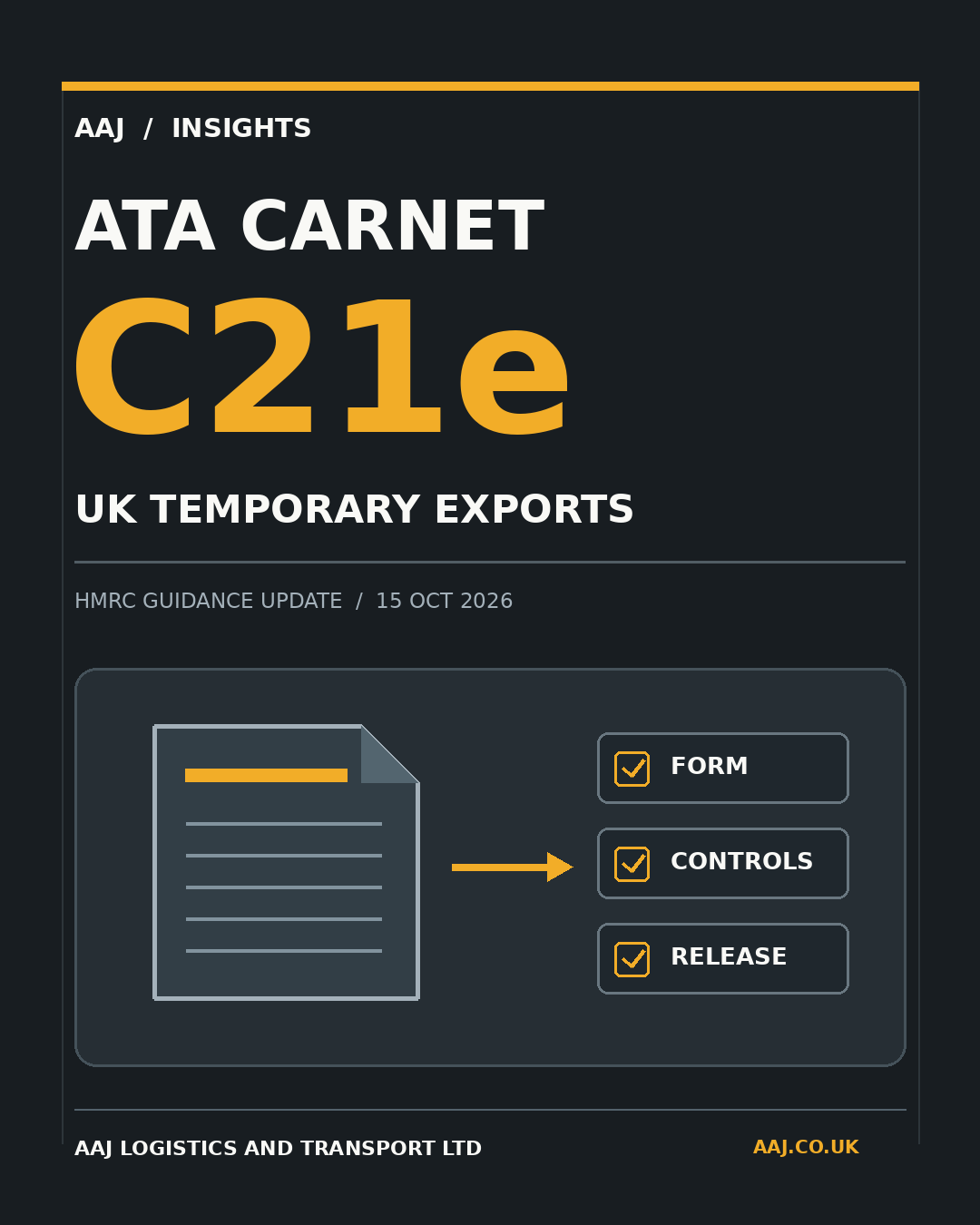
On 15 October 2026, HM Revenue & Customs updated its ATA Carnet guidance to change the freight export form reference from C21i to C21e. The amendment is concise, but operational checklists, broker instructions and port workflows often preserve old form names long after guidance changes. For temporary exports moving under an ATA Carnet, that can create avoidable questions at inventory-linked locations. The practical response is to update the reference, confirm when a C21e Customs Clearance Request is actually needed, and keep the carnet and declaration data aligned.
What HMRC changed
HMRC’s change log for “How to use your ATA Carnet” records a single amendment dated 15 October 2026: the freight export form reference was changed from C21i to C21e. The update does not announce a new temporary-export regime or alter the core purpose of the carnet. It corrects the form name that teams should use when the relevant freight or inventory process calls for a Customs Clearance Request.
That distinction matters. An ATA Carnet remains a customs document for temporary movements: the goods are expected to remain unaltered and return to the country of issue. The carnet is not a substitute for every licence, certificate, safety and security filing or location-specific release step that may apply to a shipment.
Where C21e fits in an ATA Carnet movement
HMRC’s Customs Declaration Service instructions describe C21e as the Customs Clearance Request data set used for inventory exports in defined circumstances. The associated procedure notes include goods exported or re-exported under an ATA Carnet where inventory clearance is requested. Separate additional procedure codes distinguish carnet goods that are not subject to licensing or documentary controls from those that are.
This means the correct question is not simply “Does the shipment have an ATA Carnet?” It is also “Does this location and movement require an inventory clearance request, and are any licences or documentary controls attached to the goods?” A broker or port community-system operator should confirm the required procedure and data set for the specific departure point.
Update the shipment file before dispatch
Replace C21i with C21e in internal standard operating procedures, broker templates, driver notes and customer instructions that cover ATA Carnet freight exports. If a software screen, saved email or port instruction still names C21i, confirm with the declaration provider whether the wording is merely outdated or whether the workflow itself needs correction.
Keep the carnet number, goods list, item references, vehicle or unit details and intended border office consistent across the transport file. Where the C21e instructions require a previous-document reference, HMRC’s procedure guidance uses document category Z and previous document type 955 for the ATA Carnet reference. The precise completion rules still depend on the procedure and any additional procedure code selected.
Do not overlook controlled goods
HMRC separates carnet movements that are free of licensing or other export documentary controls from those involving controlled goods. Goods subject to licences, certificates, prohibitions or restrictions need the appropriate supporting evidence and procedure treatment; the existence of a carnet does not remove those obligations.
Teams should identify controlled content early—before collection—because the documents may need to be endorsed or referenced in the customs request. The C21e procedure notes state that Data Element 6/14 is required where a document, licence or admissibility certificate must be endorsed using the C21e.
A five-point pre-departure check
First, confirm the goods are genuinely moving temporarily and are expected to return unaltered. Second, check that the carnet is valid for the countries and intended use. Third, establish whether the departure location requires inventory clearance and whether C21e applies. Fourth, identify any licences, certificates or safety and security declarations that remain necessary. Fifth, make sure the carnet reference and item-level details match the transport and customs records.
If any of these points is unclear, pause the release instruction and obtain confirmation from the customs intermediary or the operator of the departure location. A short check before dispatch is easier to manage than a mismatch at the frontier.
Takeaway
The HMRC update is narrow but operationally important: ATA Carnet freight instructions should now reference C21e, not C21i. Treat that as a checklist correction, then verify the location, procedure and control requirements for the actual shipment rather than assuming one form covers every temporary export.
Sources
- HMRC — How to use your ATA Carnet (updated 15 October 2026)
- HMRC — Using the ATA Carnet
- HMRC — C21e Additional Procedure Code 1-Series
- HMRC — Customs Clearance Request for Exports (Appendix 1)
Practical reading for this route. Check the official guidance for the circumstances of your shipment.